Blog: Altera Agilex FPGAs in Quantum Computing Data Acquisition - Sarsen Technology
TOTAL: £0.00
home

email


Search Right
Need help
 
Need help?
Contact us on
+44 1672 511166
info@sarsen.net
 
Latest News

March 2026 - HIPER Global UK Strengthens Capabilities with the Integration of Sarsen Technology

Altera Agilex FPGAs in Quantum Computing Data Acquisition


Altera Agilex FPGAs in Quantum Computing Data Acquisition


Removing the Classical Bottleneck


Posted by Nigel Norman
November 25, 2026

Quantum computing has come a long way from the physics lab. Ask a quantum hardware team where their engineering effort goes, and you might expect them to talk about qubits, but more and more, the conversation is turning to the electronics around them. 

Take a superconducting qubit. The control system has to generate precisely shaped microwave pulses and digitise a very weak readout signal. It then has to decide what state the qubit is in and, increasingly, act on that decision, all well inside the qubit's coherence time. Doing that for one qubit is a nice piece of engineering. Doing it for a few thousand channels turns data acquisition (DAQ) into the bottleneck, but how do you overcome that limitation?

Altera's approach is to put the data converters and the FPGA in the same package and build out from there. Annapolis Micro Systems then turns that silicon into COTS hardware you can actually deploy.
 

A Growing UK Quantum Sector

The UK punches well above its weight in quantum computing, helped by the National Quantum Strategy. Oxford Quantum Circuits in Reading is building superconducting machines. Universal Quantum in Haywards Heath and Oxford Ionics, now part of IonQ, are both working with trapped ions. Riverlane, in Cambridge, is tackling error correction across all of them.

These companies are taking very different routes. All of them, though, depend on fast, precise classical electronics that can scale.
 

Where the Bottleneck Lies

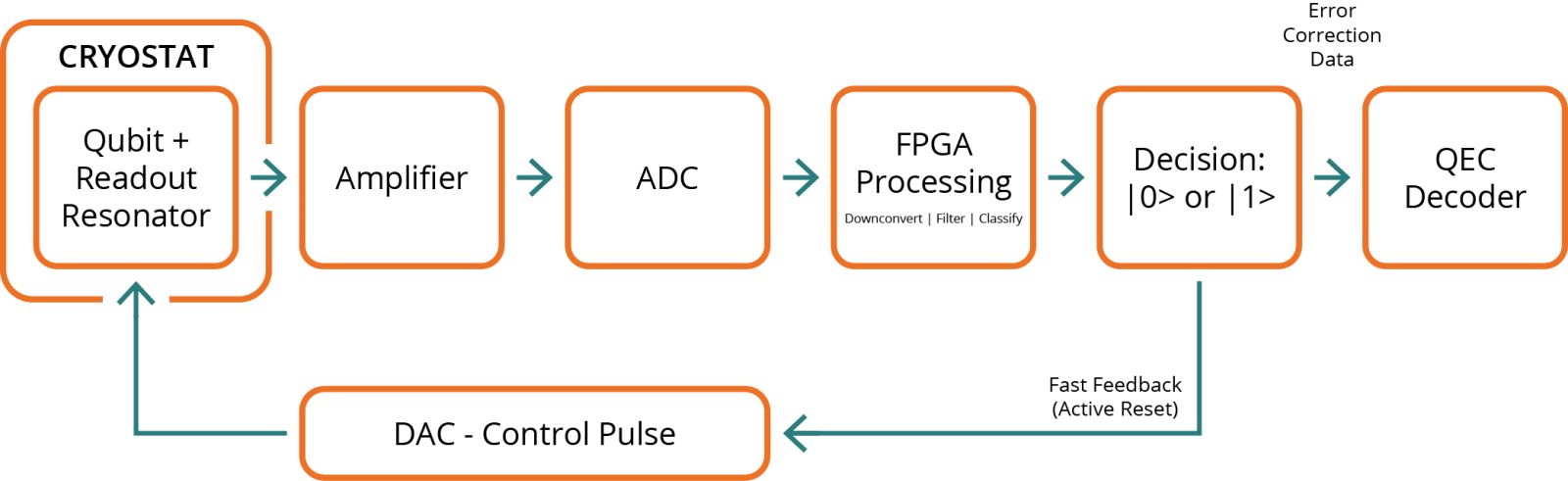
Take a typical dispersive readout on a superconducting qubit:

1. A microwave tone, usually somewhere between 4 and 8 GHz, is sent to the qubit's readout resonator.

2. The signal that comes back is shifted very slightly in phase and amplitude, depending on whether the qubit is in |0⟩ or |1⟩.

3. That signal is amplified, brought out of the cryostat and sampled by an ADC.

4. The data is downconverted, filtered and integrated, and a threshold decides the state.

5. The result might trigger the next control pulse (for an active reset, for example) or go to a quantum error correction (QEC) decoder.  
Figure 1: The qubit readout loop
 

In a conventional DAQ setup, several things get in the way.

  • First, conventional ADCs can't sample microwave signals directly. Mixers, local oscillators and IF filters have to bring the signal down to a lower frequency first. Each of those stages adds size, power, noise and drift, plus something else to calibrate.
  • Then there's the link between the converter and the FPGA. Discrete ADCs and DACs usually talk to the FPGA over JESD204B/C serial links, which adds a fixed delay to every trip around the loop.
  • And there's the sheer volume of data. One 64 GSPS, 10-bit channel produces 640 Gb/s. Multiply that by a few hundred channels, and there's no sensible way to send it all to a host, so it has to be reduced at the edge.
 

Agilex 9 Direct RF: Converters and FPGA in One Package

Altera's Agilex 9 Direct RF-Series puts high-speed data converters and FPGA fabric in a single package, joined by EMIB and AIB chiplet interconnect.

  • Wideband devices: up to eight channels each of 64 GSPS ADC and DAC, with 36 GHz of RF bandwidth and 32 GHz instantaneous bandwidth.
  • Medium-band devices: these trade sample rate for channel count and resolution. They offer up to sixteen 12 GSPS DAC channels and twenty 4 GSPS ADC channels at 14-bit, for signals up to 7.125 GHz.
  • The AGRW039, the newest wideband device, has around 45% more logic and DSP than the AGRW027, plus a quad-core Arm Cortex-A53 and DDR5 support.

The biggest change for quantum DAQ is a much simpler analogue chain. Sampling directly at microwave frequencies means the mixers and local oscillators aren't needed. Frequency translation happens digitally instead, where it doesn't drift with temperature, and channel-to-channel phase and amplitude can be calibrated in the FPGA.

Latency drops too, and just as importantly, it's fixed. The converters sit in the same package as the FPGA fabric rather than at the end of a serial link, so data reaches the processing logic quickly and predictably. For feedback operations like active qubit reset, that predictability matters, as the heavy lifting now moves to the edge. 
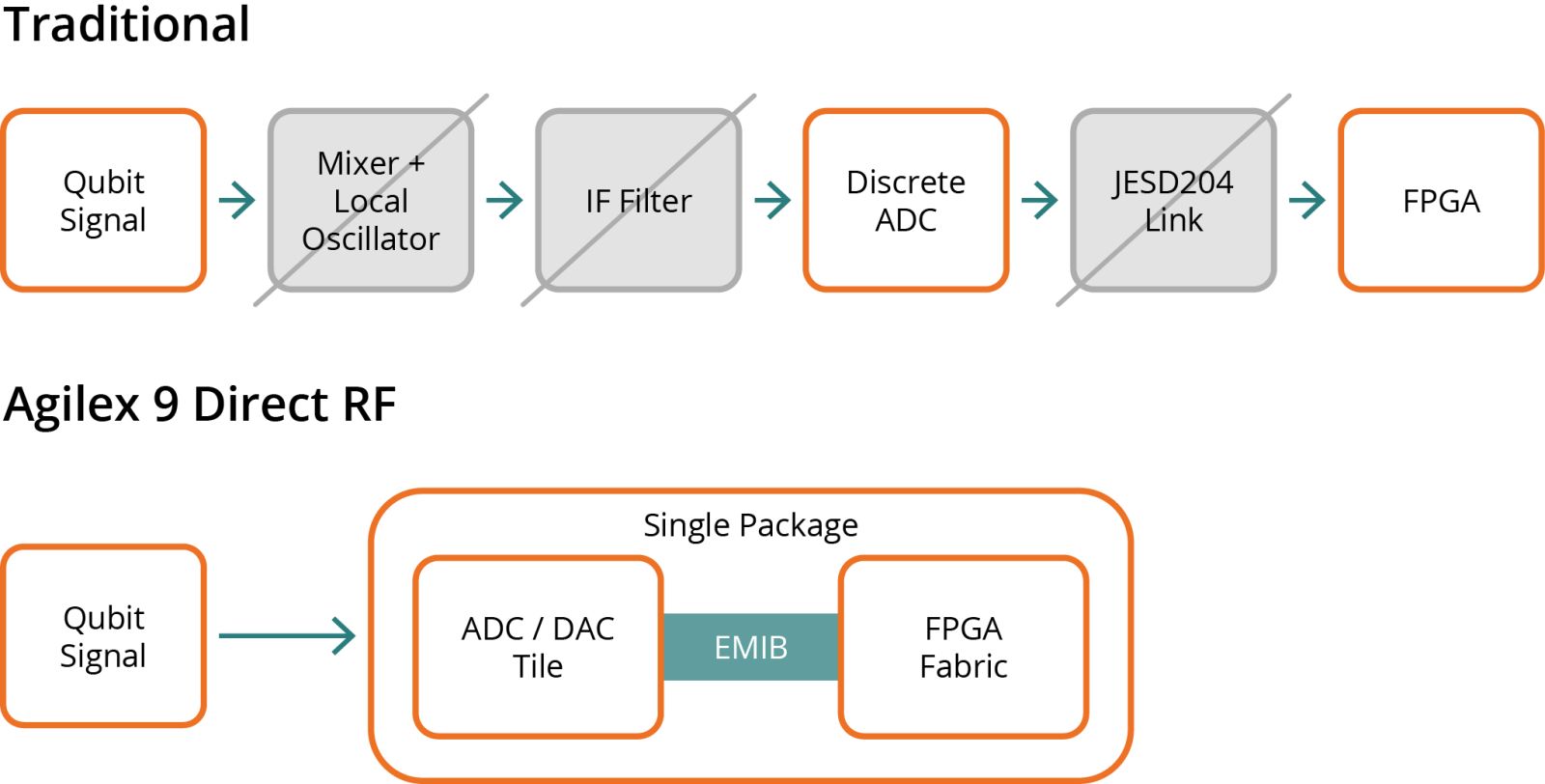
 

Figure 2: Traditional vs Direct RF signal chain
 

Agilex 7 and Real-Time Error Correction

Fault-tolerant quantum computing needs error correction running continuously, with syndrome data flowing from the control system to a decoder on a predictable schedule. In September 2026, Altera and Riverlane announced that Riverlane had validated its Quantum Error Correction Interface (QECi) design example on an Agilex 7 FPGA. The design is open source on GitHub, with the physical layer running on Agilex F-Tile transceivers.

QECi sets out how a control system and a QEC stack talk to each other, and Qblox, Rigetti and Infleqtion are among the companies adopting it. For system designers, that makes for a tidy split. Agilex 9 handles readout and control at the front end, and Agilex 7 gets the data to the decoder.
 

From Silicon to Deployable Hardware

Good silicon on its own doesn't give you a working system. It has to be built into hardware reliable enough to move from a lab bench to a production rack. Annapolis Micro Systems builds Agilex 9 Direct RF devices into COTS boards and modules, and three of its products are particularly relevant here.

WILDSTAR SAF1
The SAF1 is a small-form-factor module built around the Agilex 9 AGRW014, measuring just 24×40×102 mm. It has four channels, each with a 64 GSPS ADC and DAC at 10-bit resolution, roughly 1.4 million logic elements and a quad-core Arm processor. It pairs with modular RF and digital I/O cards, and can synchronise across multiple units. Because it's so small, it can sit close to the experiment and keep analogue cable runs short.

WILDSTAR 3AE1
If you need more channels, the 3AE1 doubles them to eight transmit and eight receive. It's built around the Agilex 9 AGRW027 on a 3U OpenVPX, SOSA-aligned board with 100GbE. An analogue interface mezzanine site takes RF cards for any front-end conditioning.

WILDSTAR WP3H20
The WP3H20 ties everything together. It's a 3U OpenVPX switch that links digitiser and control boards to host servers and QEC decoders, with 6.4 Tb/s of switching between backplane slots across 100GbE, PCIe Gen 4 and LVDS channels.
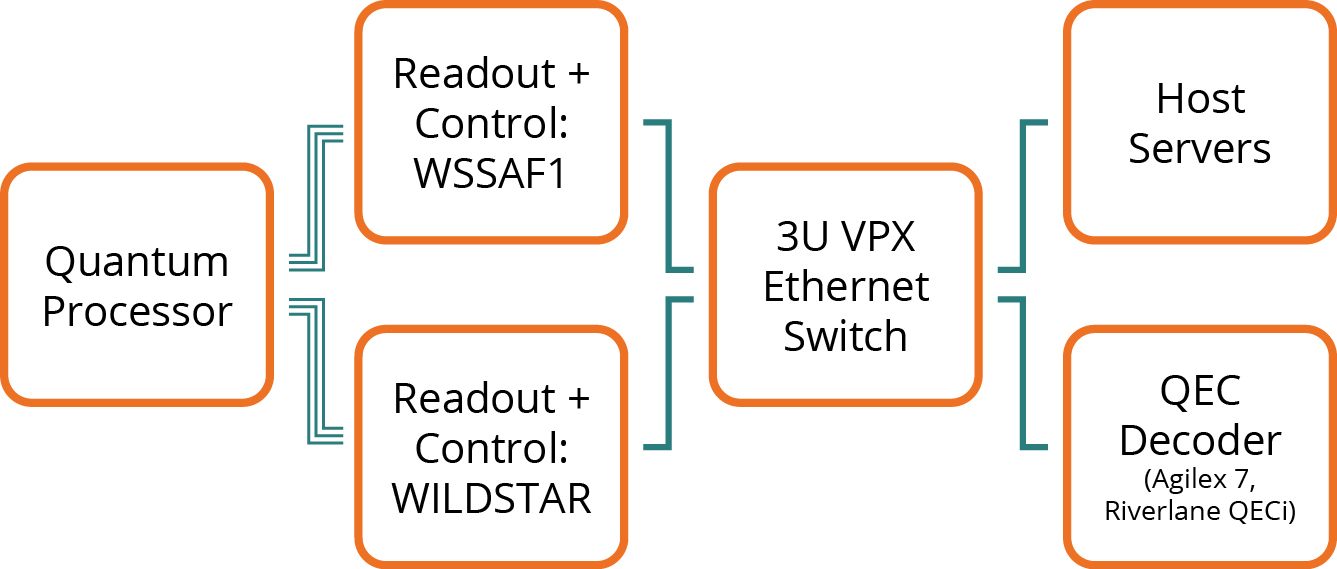
 
Figure 3: System architecture
 

Traditional vs Direct RF COTS

 
  Traditional discrete DAQ Agilex 9 Direct RF + Annapolis COTS
Analogue Chain Mixers, local oscillators, IF filters Direct sampling up to 36 GHz
Converter Interface External ADC/DAC over JESD204B/C In-package via EMIB
Data Handling Raw data sent to host Processed in FPGA fabric
Form Factor Racks of discrete RF equipment Palm-sized module or 3U VPX
Synchronisation Analogue calibration across boards Multi-unit synchronisation built in
 

Conclusion

It's easy to think of quantum computing as purely a physics problem, but scaling it up is just as much about classical engineering. Agilex 9 Direct RF eliminates the analogue front end and external converter links. Agilex 7, through Riverlane's QECi, offers a proven path to real-time error correction. Annapolis Micro Systems builds both into rugged COTS hardware that scales from a single experiment to a full system.
 

As the UK distributor for Annapolis Micro Systems, we work with engineering teams from first evaluation right through to deployment. We can help with board selection and system architecture, and arrange development kits so you can get hands-on with Agilex 9 Direct RF hardware sooner.

To talk through your quantum DAQ requirements, call us on 0118 929 4990 or email info@sarsen.net.

News

August 2026 - Alta Data Technologies Introduces Industry’s First In-Line Multi-Protocol MIL-STD-1553 & ARINC Avionics Ethernet Converter

Alta Data has announced the release of its latest network innovation, the NLINE-EMA4™. This ground...

Read more...